
In the windswept landscape of Iceland, where volcanic terrain meets brutal weather, fitness influencer Fergus Cramb traveled to test himself against one of strength sports’ most legendary challenges. The Husafell stone weighs 186 kilograms (410 pounds) and has been humbling athletes for over 250 years.
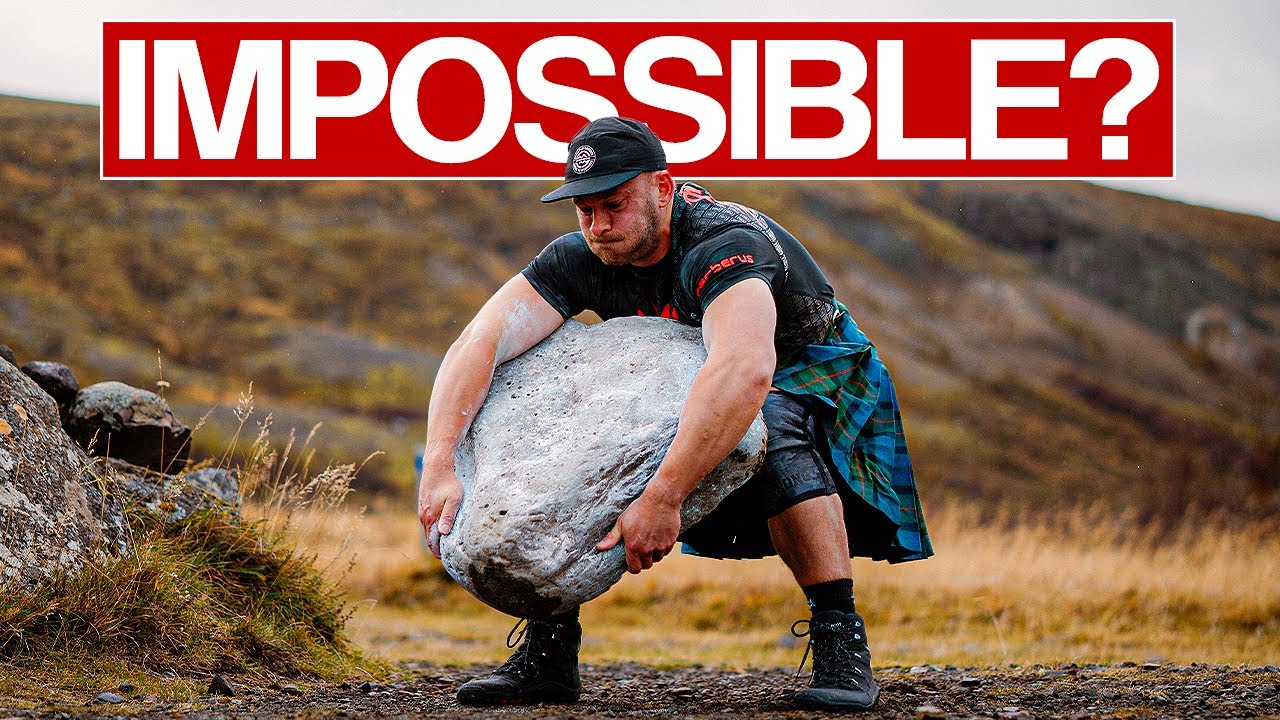
Achieving “full sturker” status—carrying this unwieldy stone one complete lap around an ancient sheep pen without setting it down—represents the ultimate test of Icelandic strength. After 15 years of lifting, Cramb was determined to prove himself worthy of this historic feat.
The Stone That Separates Pretenders From Legends
The Husafell stone sits in a remote sheep pen in Iceland’s harsh countryside, where it once served as a gate built by Reverend Snorri Björnsson in the 18th century. Travelers began using it as a strength test over two and a half centuries ago, naming it “Kviahellan.”
Three traditional challenges exist: lifting it onto the southern wall, lifting it onto a larger stone engraved with Snorri’s name, and the ultimate test—carrying it one full lap around the pen (approximately 35 meters) for full sturker status.
Iceland has produced a disproportionate number of the world’s strongest athletes. Hafþór Björnsson holds the world record deadlift and portrayed “The Mountain” in Game of Thrones. Jón Páll Sigmarsson won World’s Strongest Man four times and has become a cultural icon. Benedikt Magnússon was renowned as one of history’s best deadlifters, holding the raw deadlift world record until recently.
A Case of Mistaken Identity
Cramb’s first attempt didn’t go as planned. He successfully lifted what he believed was the Husafell stone, positioning himself carefully and managing to hoist the massive rock. There was just one problem—it was the wrong stone entirely.
The funniest thing is I was conversing with Liam in real time. I was stood over there and I was messaging him saying, ‘Hey, is this where the grips are? Is this how I should position it?’ We were going back and forth and at no point did Liam say, ‘Fergus, that’s the wrong stone, mate.’
Liam, an experienced strongman who had achieved full sturker status three times before, eventually revealed the truth. The actual Husafell stone was buried further up the pen, still covered from a recent competition.
So basically, the conditions that Fergus was lifted in was probably the worst conditions I’ve ever seen anyone attempt it in. Just so happens you got two heart-shaped stones in the pen.
The Technical Challenge of Lifting an Irregular Stone
Unlike barbells or standardized gym equipment, natural stones present unique biomechanical challenges. The weight distribution shifts unpredictably, grip points vary, and the awkward shape creates leverage disadvantages throughout the lift.
Liam’s coaching proved invaluable during Cramb’s preparation. He emphasized critical technical details that make the difference between success and failure with the Husafell stone.
The more you tilt, the less it swings when it comes off the floor. It’s that swing that causes you to lose the grip. You see in your first pull when you pulled up, it swung.
Cramb needed to position the stone so it was already angled in the direction it would naturally swing. This minimized momentum loss and preserved grip strength—both essential for completing the full lap.
The Warm-Up Strategy
Before attempting the real Husafell stone, Cramb completed a warm-up lap with the “fool’s stone”—his new name for the rock he’d mistakenly lifted earlier. This approach allowed him to practice technique and build confidence without risking early fatigue on the actual challenge.
Even during warm-up, the physical demands were apparent. Stone carrying requires not just raw strength but also significant cardiovascular endurance and mental fortitude.
Multiple Attempts and Mental Fortitude
Cramb’s journey to full sturker status required numerous attempts. Each failed lift consumed precious energy and tested his determination.
His right bicep wasn’t feeling optimal. Fatigue accumulated with each attempt. Self-doubt crept in during the repeated failures to get proper positioning off the ground.
I’ve just lost that forward straight away. Just that position. What’s going on there? I don’t want to waste any energy.
Liam’s steady coaching kept Cramb focused on technique rather than panicking about fatigue. Proper chalk application on the thighs, precise hand placement, and controlled breathing all contributed to the eventual successful lift.
The Successful Lap
When Cramb finally achieved proper positioning and lifted the authentic Husafell stone, Liam’s encouragement pushed him through the grueling lap around the sheep pen.
The carry itself represents a unique combination of strength and endurance. Unlike a max deadlift that lasts seconds, stone carrying demands sustained muscular tension, grip endurance, and cardiovascular capacity simultaneously.
I’ve seen many lifters 140, 150 kg struggle to get one lap. It’s not all just being big and strong. Strength without fitness…
Cramb didn’t just complete one lap—he managed nearly one and a half laps before setting the stone down, exceeding the requirement for full sturker status.
Why Stone Lifting Matters Beyond Numbers
Traditional strength tests like the Husafell stone challenge offer something modern gym equipment cannot replicate. They connect athletes to history, test problem-solving under physical stress, and require adaptability rather than perfected technique on standardized equipment.
Time goes on, but the stone will always weigh the same. And that’s what we are a part of now is the history of this place.
Cramb reflected on how this achievement differed from his 15 years of barbell training. Despite impressive accomplishments with conventional lifting, conquering the Husafell stone provided a unique emotional and physical satisfaction.
Practical Applications for Modern Athletes
While most people won’t travel to Iceland to lift historic stones, the principles translate to functional fitness training:
- Train with irregular objects: Sandbags, water-filled containers, and awkwardly shaped implements build practical strength.
- Combine strength with endurance: Loaded carries challenge both systems simultaneously.
- Practice problem-solving under fatigue: Complex movements when tired improve mental resilience.
- Accept imperfect conditions: Training in varied environments builds adaptability.
- Value technique over ego: Cramb’s multiple attempts showed patience and willingness to refine his approach.
The Emotional Weight of Achievement
For Cramb, achieving full sturker status represented more than physical accomplishment. He was preparing to shift his training focus almost entirely toward endurance for an upcoming project called “Project Tenacity.”
There’s a bit of ego there that’s struggling with that reality. But I know why I’m doing it. It’s for something that’s very important and meaningful for me.
This mindset reflects mature athletic development—recognizing when to pivot training focus while honoring past accomplishments. Strength training had been central to his identity for 15 years, making the transition emotionally complex despite being logically sound.
The Husafell stone provided a meaningful capstone to this chapter. Rather than simply moving to new training, Cramb created a memorable challenge that honored his strength journey while preparing mentally for what comes next.
Adventure as Training Philosophy
Strength for me is adventure. Strength for me is exploration. Strength for me is a win.
This perspective transforms training from mere physical preparation into experiential learning. Traveling to remote locations, embracing challenging conditions, and testing oneself against historic benchmarks creates richer meaning than accumulating gym PRs alone.
Iceland’s harsh volcanic landscape, brutal weather, and 250-year tradition of strength testing provided context that no commercial gym could replicate. The tranquility of the farmland valley, the heritage-rich stone, and connection to legendary Icelandic strongmen elevated the experience beyond athletics into something genuinely special.
Modern fitness culture increasingly recognizes this broader definition of strength—not just numbers on a bar, but capability, resilience, and willingness to embrace discomfort in pursuit of meaningful challenges. Cramb’s journey to full sturker status exemplifies this philosophy perfectly.