
PHOENIX — A significant controversy erupted recently when the Chicago Bulls cut guard Jaden Ivey after he publicly expressed his opposition to gay pride events. The fallout from this decision ignited a fierce debate across social media, with people aligning themselves on various sides. This public discourse quickly extended to the NFL, where New England Patriots running back TreVeyon Henderson took to social media to defend Ivey, quoting the Bible in the process.
TreVeyon Henderson Speaks Up For Ivey
In an emotionally charged response, Henderson cited Scripture: “Blessed are those who are persecuted for righteousness’ sake, for theirs is the kingdom of heaven,” a line from Matthew 5:10. This quote highlighted his belief that Ivey is facing persecution for his views, which he characterizes as rooted in righteousness.
Henderson’s response did not go unnoticed. Questions about his stance reached New England Patriots coach Mike Vrabel at the NFL annual meeting, where he was asked to define the line between a player’s personal opinions and what might be considered detrimental to the team. Vrabel’s response encompassed a delicate balance of support and caution.
“I think there’s a fine line,” Vrabel stated. “I love TreVeyon. He cares deeply about our team, his faith, and his family. I want them to express what they believe, but I also want to ensure that they’re educated and that we create an inclusive environment.” His comments reflected an intention to foster open dialogue while navigating the complexities of modern social issues.
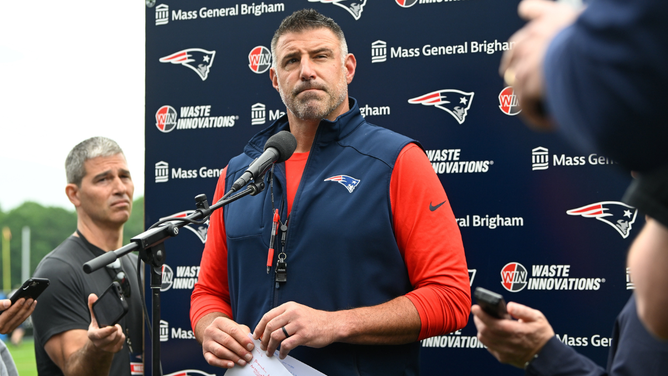
(New England Patriots coach Mike Vrabel. Photo: Eric Canha-Imagn Images)
Vrabel’s Support For Henderson Conditional
There’s considerable nuance to unpack in Vrabel’s statements. Importantly, he acknowledges that every player serves as a representative of their team. Henderson, too, must navigate this role while sharing his beliefs. However, the implication that defending one’s faith could somehow tarnish the team’s reputation raises ethical questions.
To categorize Henderson’s scriptural defense as potentially detrimental to team unity could equate his position to those of players caught in scandals involving substance abuse or criminal activity—an uncomfortable comparison. Henderson’s expression of faith appears to be a personal statement rather than a professional failing.
In this same exchange, Vrabel juxtaposed Henderson’s comments with a situation involving Stefon Diggs, who faced serious legal issues related to felony strangulation and misdemeanor assault. This glaring contrast in scenarios amplified concerns regarding Vrabel’s balancing act in his commentary.

New England Patriots running back Treveyon Henderson before Super Bowl LX against the Seattle Seahawks at Levi’s Stadium. Photo: Darren Yamashita-Imagn Images
Henderson Needs Education?
Vrabel also underscored the importance of education, suggesting that Henderson should be well-informed about his beliefs and their potential impact. This brings forth an unsettling implication: is Henderson’s understanding of social issues inadequate? The notion that players might need “education” to align with progressive ideals could be perceived as a form of ideological conditioning.
Interestingly, while Vrabel attempts to convey support for Henderson, his statements hint at a desire for conformity to what can be construed as a more inclusive narrative. The challenge lies in balancing personal beliefs with the collective ethos of a team that represents diverse backgrounds and viewpoints. In doing so, Vrabel may inadvertently discourage authentic dialogue about faith and its implications in a modern, complex society.